

Please Choose Your Language
Views: 0 Author: Site Editor Publish Time: 2026-06-26 Origin: Site


Suboptimal illumination in automated quality control creates hidden operational burdens. When inspecting highly reflective, curved, or complex geometries, traditional direct lighting often fails. It generates harsh hotspots and deep shadows that blind camera sensors, degrade inspection algorithms, and ultimately lead to false rejects or missed defects. Engineering teams frequently spend hours tweaking software thresholds to compensate for poor lighting, which only masks the root problem.
Achieving reliable defect detection on challenging surfaces requires uniform, diffuse lighting. The smart dome light serves as the definitive solution for continuous, multidirectional illumination. By integrating programmable, intelligent features, these fixtures elevate standard machine vision illumination from a passive hardware component into an active, data-driven asset that adapts to dynamic production environments.
Smart dome lights provide "cloudy day" illumination, effectively eliminating hotspots and shadows on specular, curved, or uneven surfaces.
Integrated smart controllers allow for dynamic strobing, intensity adjustments, and multi-zone control without requiring external hardware.
While highly effective for defect detection, traditional dome lights require significant physical clearance; evaluating spatial constraints is critical before specification.
Upgrading to industrial machine vision LED lights with smart capabilities directly improves overall equipment effectiveness (OEE) by reducing false positive rates in automated optical inspection (AOI).
Defining the baseline requirement for inspecting reflective materials—such as machined metal, foil packaging, or glass—starts with understanding the interaction between light and the target surface. Success relies entirely on achieving uniform light distribution across the camera's field of view. When inspecting a curved metallic component, direct light reflects straight back into the lens, causing blooming. The inspection algorithm cannot process data within that saturated region, leading to critical inspection failures. You need a setup that scatters the photons evenly before they hit the target.
The solution lies in the "cloudy day" effect. This physical phenomenon relies on indirect, highly diffuse lighting. Light is emitted upward into the interior of a coated hemisphere. The specialized matte coating scatters the photons, bouncing them down onto the target from every possible angle. This continuous geometry wraps the object in shadowless light, revealing surface topology, printed text, and microscopic defects without the interference of specular glare. Think of inspecting a polished aluminum soda can; direct ring lights will just show you the shape of the LEDs, whereas a diffuse hemisphere reveals the actual printed barcode and any micro-scratches on the metal.
Differentiating a basic fixture from a smart unit is necessary for modern automation. While standard units provide the necessary optical geometry, smart models incorporate built-in overdrive capabilities, active thermal monitoring, and programmable trigger inputs. This allows the lighting system to communicate directly with the camera and programmable logic controller (PLC), ensuring precise synchronization and operational longevity.
Feature | Standard Dome Fixture | Smart Dome Fixture |
|---|---|---|
Control Mechanism | Requires external strobe controller | Integrated internal controller |
Thermal Management | Passive heatsink only | Active temperature monitoring and current throttling |
Strobe Capability | Limited by external hardware latency | Microsecond precision with built-in overdrive capacitors |
Wiring Complexity | High (multiple cables to external boxes) | Low (direct trigger from camera or PLC) |
The continuous indirect lighting geometry prevents direct LED reflection from blinding the camera sensor. By converting point-source LEDs into a massive, uniform emitting area, the fixture provides high-contrast imaging. Scratches, dents, and printed barcodes on glossy pharmaceutical blister packs or polished automotive bearings become distinctly visible. The vision software can then perform accurate edge detection and pattern matching without dealing with blown-out pixels.
Consider the inspection of solder joints on a printed circuit board (PCB). Solder is highly reflective and curved. Direct lighting creates intense specular highlights that confuse automated optical inspection (AOI) systems. By wrapping the joint in diffuse light, the system can accurately measure the volume and shape of the solder fillet, ensuring it meets quality standards.
Modern production lines operate at extreme speeds, requiring short camera exposure times to prevent motion blur. Smart controllers utilize built-in capacitors to overdrive the LEDs, delivering microsecond pulses of intense light. This freezes motion effectively while maintaining the high intensity required for crisp image capture. Integrated controllers manage the current precisely, preventing LED degradation during these high-output strobe cycles.
The PLC sends a trigger signal as the part breaks the photoelectric sensor beam.
The integrated smart controller receives the signal and instantly discharges its capacitors.
The LEDs pulse at 300% of their continuous current rating for exactly 50 microseconds.
The camera exposes the frame simultaneously, capturing a perfectly frozen, brightly lit image of the moving part.
The controller drops the current back to zero, allowing the LEDs to cool before the next trigger.
Advanced industrial machine vision LED lights often feature multi-spectral arrays, such as combined RGB and IR LEDs, or independent quadrant control. This allows a single inspection station to perform multiple distinct tasks sequentially. A system can trigger red light to verify a printed lot code, followed immediately by a low-angle directional pulse from one quadrant to highlight an embossed feature. This versatility eliminates the need for multiple physical inspection stations.
For example, in food packaging, you might need to verify a red printed expiration date and also check the integrity of a clear plastic seal. A multi-wavelength fixture can flash red light to maximize contrast on the print, and then flash ultraviolet or infrared to inspect the seal, all within milliseconds while the package moves down the conveyor.
Factory floor environments are optically noisy. Natural light from skylights shifts throughout the day, and overhead bay lighting can introduce flickering. Smart fixtures adapt to these variables utilizing precise timing and high-output pulsing. By strobing the light at an intensity far exceeding ambient levels and pairing the camera lens with a matching optical bandpass filter, the vision system effectively rejects all external light pollution, ensuring consistent illumination levels.
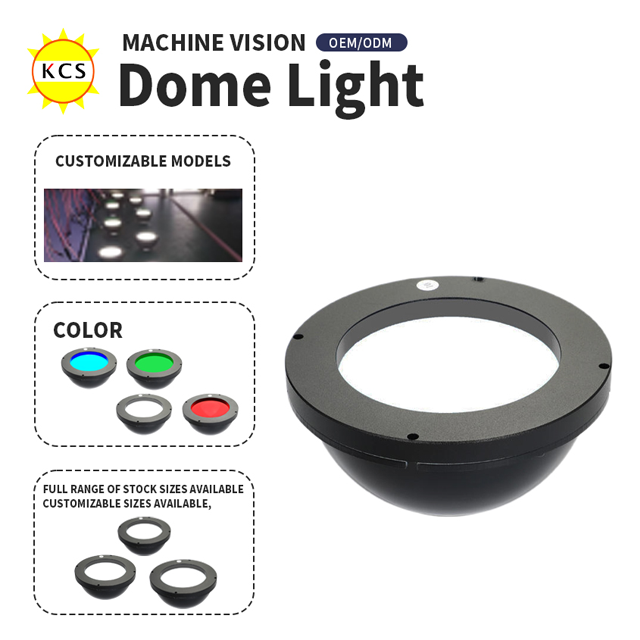
Form factor plays a major role in hardware specification. Traditional hemispherical domes offer superior uniformity because their physical depth allows for optimal light scattering. However, they require substantial vertical clearance. Flat dome lights utilize edge-lit light guides with specialized micro-structured diffusion patterns to mimic the cloudy day effect. While they save significant space, they may exhibit slight intensity drop-offs at the edges compared to their hemispherical counterparts.
Specification | Hemispherical Dome | Flat Dome |
|---|---|---|
Uniformity | Excellent (True 3D scattering) | Good (2D edge-lit diffusion) |
Vertical Space Required | High (Often 100mm+) | Low (Often under 20mm) |
Best Application | Highly curved, complex reflective parts | Slightly curved or flat reflective parts in tight spaces |
Camera Mounting | Through top aperture | Through center hole or mounted alongside |
Application fit determines the choice between these two diffuse lighting techniques. Dome fixtures excel at illuminating curved, crinkled, or uneven reflective surfaces because light hits the target from all angles. Coaxial lights, which use a beam splitter to direct light perfectly parallel to the camera's optical axis, are strictly suited for perfectly flat, mirrored surfaces like silicon wafers or flat glass panels. If you use a coaxial light on a curved surface, the light will bounce away from the lens, creating dark spots.
Scalability and panel space drive the decision between integrated and external control. Purchasing a fixture with an integrated smart controller simplifies wiring, reduces the physical footprint in the control cabinet, and minimizes points of failure. Conversely, standard lights paired with advanced external strobe controllers offer modularity, allowing engineers to swap out individual components if a specific part fails or if the application requires a specialized third-party controller for complex multi-camera sequencing.
Ruggedness and reliability separate professional hardware from commercial alternatives. Professional machine vision light solutions are IP-rated against dust and fluid ingress, utilize heavy-duty aluminum housings for thermal management, and undergo rigorous binning for color consistency. Entry-level or commercial LED rings lack this repeatability, thermal stability, and continuous-run durability, leading to rapid degradation and inconsistent inspection results in harsh manufacturing environments. When a commercial LED overheats, its spectral output shifts, which can instantly break a color-verification algorithm.
The financial payback of upgrading to optimized lighting is calculated by quantifying the reduction in manual inspection overhead and scrap. Lighting-induced false positives force operators to manually verify parts, slowing down production and increasing labor costs. By providing clear, high-contrast images, the vision system makes definitive pass/fail decisions, directly improving overall equipment effectiveness.
Consider a line producing 100,000 parts a day. If poor lighting causes a 2% false reject rate, that is 2,000 good parts flagged as bad daily. Operators must manually sort these, wasting hours of labor. Upgrading the illumination to eliminate those false rejects pays for the hardware investment rapidly through labor savings and increased throughput.
Smart fixtures actively monitor their own internal temperature and optimize current draw. Utilizing automated "sleep" or "idle" low-power states during manufacturing line pauses prevents unnecessary heat buildup. This thermal management extends the functional lifespan of the LEDs in 24/7 continuous operations, reducing maintenance interventions and replacement frequency.
LEDs degrade faster when exposed to high heat. By keeping the junction temperature low through smart current management and heavy-duty aluminum heatsinks, industrial fixtures maintain their brightness over tens of thousands of hours. This stability means engineers do not have to constantly adjust camera exposure times to compensate for dimming lights.
Integration ROI is realized through reduced engineering hours and wiring complexity. Smart fixtures that interface directly with the camera, frame grabber, or PLC via standard industrial protocols streamline the deployment process. This plug-and-play architecture reduces hardware costs by eliminating the need for intermediary relays or external timing boards.
Hemispherical fixtures are inherently bulky. They must be mounted very close to the target to ensure the light wraps around the object effectively. This proximity can interfere with robotic tooling, pick-and-place nozzles, or material handling mechanisms. Conducting 3D CAD clearance studies prior to specification is mandatory. If the working distance or vertical clearance is severely restricted, engineers must consider flat dome alternatives.
Import the 3D step file of the chosen lighting fixture into the machine assembly CAD model.
Position the fixture at the manufacturer's recommended working distance from the inspection target.
Simulate the full range of motion for any nearby robotic arms, clamps, or conveyors.
Check for any physical collisions or line-of-sight obstructions.
Adjust the mounting brackets or select a lower-profile fixture if collisions are detected.
The camera must view the part through an opening at the top of the fixture. If this hole is too small relative to the lens diameter and working distance, it causes mechanical vignetting, cutting off the corners of the image. If the hole is too large, it creates a dark spot in the center of the illumination field, destroying the uniformity. Matching the lens field of view and working distance precisely to the manufacturer's specified aperture dimensions mitigates this risk.
Mismatched timing between the smart light trigger, camera exposure, and part position leads to dark, partially illuminated, or blurred images. Software or network-based triggers often introduce unacceptable jitter. Utilizing hardware-based triggering—wiring the sensor directly to the light and camera—ensures microsecond-level synchronization, guaranteeing the strobe fires exactly when the part is centered in the field of view.
Constant high-intensity, high-speed flashing of visible LEDs causes severe eye strain, fatigue, and safety concerns for nearby operators. Deploying an infrared (IR) machine vision dome light makes the strobe completely invisible to the human eye while remaining highly sensitive to the camera sensor. Alternatively, utilizing integrated light-shielding shrouds blocks the visible flash from the operator's line of sight.
Smart dome lights are an indispensable investment for machine vision applications involving highly reflective, uneven, or curved surfaces where traditional direct lighting fails. They transform complex optical challenges into stable, repeatable inspection processes.
Base the final hardware selection on four factors: the degree of surface reflectivity, available physical mounting space, operator safety and ergonomic requirements, and the required inspection speed, which dictates the strobing parameters.
To ensure successful deployment, take the following next steps:
Request a feasibility study or loaner unit from your vision integrator to test the specific fixture against actual production samples.
Verify mechanical clearances in your CAD environment before finalizing the bill of materials.
Confirm trigger wiring diagrams to ensure hardware-level synchronization between the sensor, light, and camera.
A: It is used to provide highly uniform, diffuse illumination to eliminate glare and shadows when inspecting reflective, curved, or complex surfaces in automated quality control.
A: Smart dome lights feature integrated controllers that allow for programmable intensity, high-speed strobing, thermal monitoring, and sometimes multi-zone or multi-color control without external hardware.
A: A standard dome is hemispherical and offers the best light uniformity but requires significant vertical space. A flat dome uses edge-lit technology to mimic this effect in a much thinner profile, ideal for space-constrained machines.
A: Yes, smart dome lights can be overdriven (strobed at higher-than-continuous currents) for fractions of a millisecond to freeze motion on high-speed lines while delivering massive amounts of light.
A: The dome must be significantly larger than the object being inspected to ensure the light wraps around the part. Additionally, the top aperture must be sized correctly to accommodate the camera lens without causing vignetting or dark spots.
A: Commercial LEDs lack the output stability, precise trigger timing capabilities, rugged IP-rated enclosures, and thermal management necessary to maintain identical imaging results over millions of cycles in industrial production environments.


