

Please Choose Your Language
Views: 0 Author: Site Editor Publish Time: 2026-08-12 Origin: Site


Upgrading or implementing a multi-zone lighting system requires moving beyond basic switches. At the enterprise or industrial level, selecting the wrong multi-channel control system causes severe problems. It often leads to integration failures, visible latency, or hardware incompatibility. These issues quickly derail project timelines. They also compromise operational stability across your facility. Whether integrating a machine vision system, managing architectural lighting, or synchronizing external displays, your decision matters. The choice hinges on specific technical thresholds. You must understand how these systems process data. This guide provides an evidence-based evaluation framework. We help you match controller specifications against your exact operational requirements. You will learn to navigate protocol compatibility and channel mapping. By the end, you will confidently evaluate complex performance metrics.
Channel Mapping is Critical: Ensure your controller’s channel capacity aligns with your fixture profiles; utilizing a 4-channel controller for 9-channel fixtures requires complex software patching and often limits functionality.
Protocol dictates Integration: Native support for your ecosystem’s protocol (DMX, DALI, or proprietary Ethernet) prevents costly middleware workarounds.
Precision vs. Application: High-speed trigger responses are mandatory for machine vision, while smooth dimming curves and energy compliance matter more for architectural or commercial deployments.
Total Cost goes Beyond Hardware: Factor in cabling infrastructure, software licensing, and future scalability when evaluating a light source controller.
You must first identify your primary use case. Different environments demand vastly different hardware capabilities. Industrial machine vision requires high-speed strobing. It demands microsecond accuracy to capture moving objects. Commercial architecture relies on smooth ambient transitions. These environments prioritize occupant comfort and seamless daylight harvesting. Stage and event lighting requires complex sequence programming. These entertainment setups often use hundreds of individual channels.
You need to establish baseline metrics early. Document your required minimum response time. Calculate the maximum current per channel. Define your operating environment constraints. Industrial plants often face strict thermal limits. Outdoor installations demand high IP ratings to resist moisture. Understanding these baselines prevents critical failure.
Avoid over-specification during the planning phase. Do not pay a premium for sub-millisecond trigger latency if unnecessary. A controller managing static commercial lighting does not need machine vision speeds. Basic signage requires reliability over extreme precision. Aligning specs to reality optimizes your hardware deployment.
Audit your existing infrastructure before buying new hardware.
Measure the ambient temperature inside your server racks.
Determine if your setup requires continuous operation or intermittent bursts.
Consult IEEE standards for recommended flicker-free operating thresholds.
Below is a comparison of typical requirements across different applications.
Application Type | Primary Requirement | Secondary Requirement | Typical Environment |
|---|---|---|---|
Industrial Machine Vision | Microsecond trigger sync | Overdrive capabilities | Factory floors, assembly lines |
Commercial Architecture | Smooth 16-bit dimming | Daylight integration | Offices, retail spaces |
Stage & Event | Complex programming | Rapid refresh rates | Theaters, arenas |
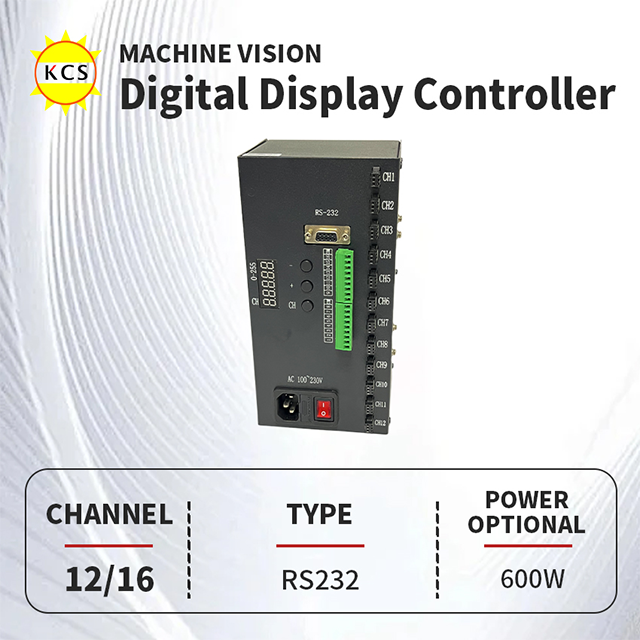
Protocol compatibility dictates the success of your integration. You must evaluate native support for industry-standard protocols. DMX512 remains the standard for entertainment and dynamic lighting. RDM allows two-way communication for remote device management. DALI is the backbone of commercial building automation. The older 0-10V standard still works for basic dimming setups. Matching your hardware to these protocols prevents operational bottlenecks.
Many modern applications involve screens, signage, or visual inspections. You must verify seamless integration in these scenarios. A robust Light Source Controller should sync perfectly across your network. It needs to communicate clearly and rapidly. You must ensure it aligns accurately alongside your Digital Display Controller. This precise synchronization prevents visible flicker. It also eliminates banding and annoying refresh-rate conflicts.
Network and API accessibility offer advanced control layers. You must assess whether the system allows third-party API integration. Ethernet-based control protocols like Art-Net or sACN push massive data payloads. Direct Programmable Logic Controller (PLC) communication is vital for manufacturing. These integration points reduce relying on fragile middleware.
Assuming all DMX controllers support RDM automatically.
Mixing DALI and 0-10V signals on the same wiring bus.
Ignoring network bandwidth limits when pushing Art-Net data.
Current control and dimming resolution fundamentally impact output quality. You must choose between Constant Current Reduction (CCR) and Pulse Width Modulation (PWM). CCR provides true flicker-free operation by lowering the actual current. PWM pulses the light rapidly to simulate dimming. High-frequency PWM works well but can cause camera artifacts. Your choice depends entirely on your specific flicker-free requirements.
You must evaluate dimming resolution carefully. Standard 8-bit dimming provides 256 steps of intensity. This often causes visible stepping or banding during slow fades. A 16-bit system provides 65,536 steps. This higher resolution is necessary for imperceptible low-end dimming. Architectural settings require 16-bit control for premium aesthetics.
Industrial settings require intense trigger response times. You must assess microsecond-level latency limits. Look for hardware featuring safe overdrive capabilities. The controller must sync perfectly alongside high-speed camera shutters. Even a one-millisecond delay ruins visual inspection data.
You must calculate power output per channel precisely. Follow these steps to ensure safe operation:
Determine the maximum wattage rating per individual channel.
Calculate the total aggregate load across all active channels.
Compare this total against the internal power supply rating.
Install external relays if your load exceeds the onboard limits.
Overloading channels causes hardware to overheat quickly. This shortens the lifespan of your entire control system.
Deploying multi-channel systems introduces the channel deficit risk. This common deployment issue derails ambitious lighting designs. You might mismatch controller capabilities against actual fixture demands. Running out of DMX addresses halts installation progress. Exhausting physical ports requires immediate hardware expansion.
Zoning flexibility determines your daily operational ease. You must evaluate the included configuration software. Check how intuitively it allows grouping channels into logical zones. Good software lets you drag and drop fixtures virtually. Complex menus frustrate technicians and delay programming.
You must understand degraded functionality mapping. Sometimes, you map a complex multi-color fixture onto limited hardware. You will face mandatory operational compromises. For example, you might sacrifice independent strobe control. You might settle for basic RGB mixing instead of advanced macros. Complex fixtures require matching channel counts to unlock all features. Under-specifying your controller forces these frustrating software patches.
Consider a facility deploying new robotic assembly lines. They installed 9-channel inspection lights. However, they purchased 4-channel output hubs. The engineers spent days writing custom patches. They eventually merged the white and amber channels. This compromised their inspection accuracy. Matching channel counts directly prevents this engineering nightmare.
Expansion capabilities define the lifespan of your installation. You must determine if the system allows seamless daisy-chaining. Some controllers easily link together via Ethernet. Others require an entirely parallel system once you hit channel capacity. Planning for future node additions saves significant engineering time later.
Compliance and energy management represent non-negotiable enterprise requirements. You must verify essential hardware certifications like UL or CE. These marks ensure the controller meets strict electrical safety standards. Uncertified hardware introduces severe fire risks into your facility.
You should also assess built-in energy management features. Look for systems supporting automated load shedding. This feature automatically reduces power draw during peak grid hours. Ambient light sensor integration is equally valuable. It adjusts output based on natural sunlight levels. These features directly support strict building energy codes.
Isolate lighting control networks from public-facing guest Wi-Fi.
Change default manufacturer passwords immediately upon installation.
Use opto-isolated splitters to protect consoles from power surges.
Update controller firmware regularly to patch network vulnerabilities.
Selecting a multi-channel system is an exercise in matching hardware limits against environmental realities. Success requires balancing channel counts and protocol alignment. You must secure necessary precision without overspending on irrelevant specifications. Understanding your primary use case dictates the entire purchasing journey. Proper planning prevents frustrating software patches and hardware bottlenecks down the road.
Take actionable steps before generating your next purchase order. First, thoroughly audit your current fixtures. Map out your required physical zones and network topology. Finally, request detailed technical specification sheets from manufacturers. You must verify absolute compatibility alongside your existing digital display infrastructure. Proactive verification guarantees a seamless, robust, and highly responsive installation.
A: Technically yes, but you face severe limitations. You will only be able to control the first 4 parameters of the fixture (e.g., Red, Green, Blue, Dimmer). Advanced functions like localized strobing, macro effects, or independent white control (channels 5-9) will remain inaccessible. You can use specific software patching to merge functions, but this often degrades overall performance.
A: A driver primarily converts and regulates power to turn the LED on safely. A controller dictates how and when that power is applied. It actively interprets data protocols to manage dimming curves, color mixing, timing sequences, and external trigger synchronization.
A: Ensure your controller uses high-frequency PWM (typically above 3000Hz) or Constant Current Reduction (CCR) dimming. Additionally, verify it can genlock or synchronize its output refresh rate directly with your display controller or camera hardware.


